







It’s a time for adapting at Crossroads—we are adapting to short days and long nights, sudden shifts in weather, and the presence or absence of snow and ice. Even so, we have many activities scheduled, including outdoor programs, and we will continue to adapt to changing conditions.
Our Ski-for-Free Program is a good example. This Crossroads tradition has gone through many adaptations over the past 25 years. We lend skis, poles, boots, snowshoes and kicksleds in a wide range of sizes. This year, equipment distribution has moved to the lower level of the Collins Learning Center, and our open hours have been significantly expanded.
Experience has taught us, however, that winter conditions can change quickly, so Ski-for-Free hours will always depend on several factors. Trail conditions must be just right, with enough snow of adequate depth and consistency to be “rolled” into a base. Without a base, the groomer cannot set tracks.
Because visitor safety is our priority, we will not open during periods of extreme cold or high winds. Finally, we must have enough volunteers available to help properly fit participants with equipment. If conditions are appropriate, skis and kicksleds will be made available in the afternoons during business hours and on weekends as staffing allows. Please check the ticker on our website and our calendar for updates.
Snowshoes will be made available all winter long during business hours and during Ski-for-Free.
Please note that Crossroads trails are always open and free, and visitors are welcome to use their own equipment at any time. Current trail conditions and Ski-for-Free hours will be posted on the ticker at the top of the Crossroads website, www.crossroadsatbigcreek.org.
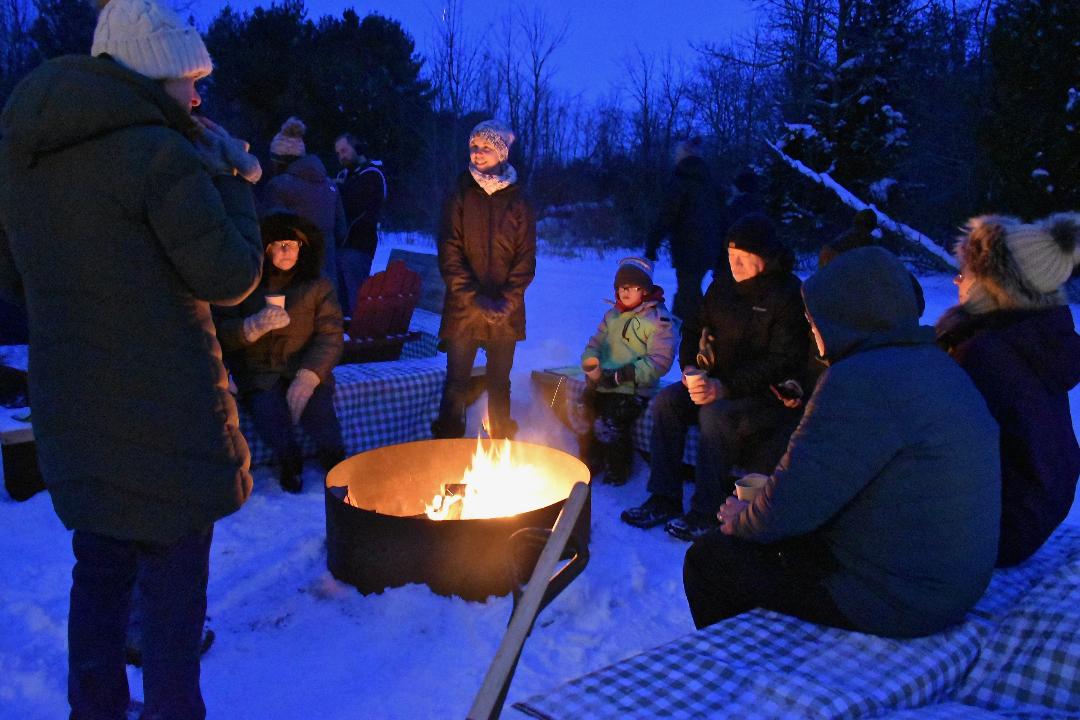
On Friday, Jan. 16, between 5 and 6:30 p.m., Door County residents and visitors can experience our trails in a different light during the Winter Sky Luminary-Lit Hike and Campfire Gathering. Candlelight will guide the way, and at the end of the trail, participants can gather with friends to share a blazing campfire and a cup of hot chocolate.
The word luminary comes from the Latin lumen, meaning light. While the human eye can adapt somewhat to darkness, early humans were largely confined to daylight until the discovery and control of fire led to the first torches.
You may be familiar with mullein, the tall plant with fuzzy leaves that grows in disturbed areas throughout our region. Long ago, people in Europe discovered that by soaking mullein’s tall, pithy stalks in animal fat, they could create effective torches.
Later, fibers from mullein and other plants were used to make wicks for oil lamps and candles. During the Middle Ages, beeswax candles were developed as a cleaner alternative to tallow. Over time, other fuels—including spermaceti from whales and 19th-century paraffin wax—were used to extend light into the dark hours.
Adaptation is also the theme of our Science Saturday program on Saturday, Jan. 17, titled Fit the Bill. This family program explores the adaptations that enable birds to use a wide variety of food sources. That discussion naturally raises another question: Do birds have adaptations that allow them to fly—and navigate—in the dark?
They do. Birds have eyes that are more sensitive to low light than humans, and research suggests young birds learn the pattern of stars rotating around the North Star to orient themselves.
Remarkably, it seems that birds can sense Earth’s magnetic field through specialized proteins containing iron in their eyes. Scientists have also discovered that at dusk, light becomes polarized—vibrating in organized directions—allowing birds to determine direction even on cloudy days and after sunset.
It is a season of adaptation—and occasionally unavoidable program cancellations—so we encourage everyone to check the Crossroads website before heading out.
Wednesday, Jan. 14
1:30 p.m. Wandering Wednesday
Join a naturalist-led guided hike to places of interest. Easy walking, about an hour. Free and open to the public. Meet at the Collins Learning Center, Crossroads, Sturgeon Bay, Wisconsin.
Friday, Jan. 16
5–6:30 p.m. Winter Sky Luminary-Lit Hike and Campfire
Take a stroll along one of our trails, beautifully lit by the enchanting glow of luminaries. When you return, cozy up around a blazing campfire with a cup of hot chocolate and enjoy the company of good people. Well-behaved dogs on leash are welcome. Free and open to the public. Meet at the Collins Learning Center, Crossroads, Sturgeon Bay, Wisconsin.
Saturday, Jan. 17
2 p.m. Science Saturday: Fit the Bill
Through hands-on demonstrations, learn how bird bills are like tools. This weekly family program is intended for elementary students, but learners of all ages are welcome. Registration not required. Free and open to the public. Meet at the Collins Learning Center, Crossroads, Sturgeon Bay, Wisconsin.
Monday, Jan. 19
Nature Center Closed
Trails open.
Tuesday, Jan. 20
3:30 p.m. Environmental Exploration: Under the Bark
This after-school outing will explore how insects and fungi survive in winter under tree bark. Geared for elementary students, but learners of all ages are welcome. Dress for outdoor conditions. Free and open to the public. Meet at the Collins Learning Center, Crossroads, Sturgeon Bay, Wisconsin.

