








We at Crossroads are well into our Fish Tales Lecture Series, and plans already are underway for educational events tied to the annual fish migration. But for now, we pause — because we are located in Sturgeon Bay, and naturally, we will be celebrating the Fire & Ice Festival.
In fact, Fire & Ice kicks off at Crossroads with our luminary-lit hike Friday night. Then, on Valentine’s Day, we will offer our Science Saturday special, “Ice Harvest Demonstration.” During this event, interpreters from the Madden Tool Museum will guide visitors in using the simple machines once employed to harvest ice from the Bay of Sturgeon Bay.
We still have no idea how “Fire & Ice” became the name for Sturgeon Bay’s winter festival, but it seems fitting. In a very real way, the city of Sturgeon Bay was shaped by fire and ice. For that reason, we’ve never felt that our events stray from our environmental education themes.
But is there a connection between fire, ice and fishes?
Absolutely — and that connection is the Sturgeon Bay Ship Canal.
In unpublished notes archived in the Laurie Room of the Sturgeon Bay Library, late mayor and historian Stanley Greene wrote:
“In 1864, a company was chartered to dig the canal. The state Legislature gave them a grant of 200,000 acres to finance the project [digging began in 1871]. But the timing was bad. The canal was grounded by lack of funds.
“By 1873, about a quarter of the project was complete, making the company eligible for its first allotment of land, which it could sell to raise revenue for the next phase. That same year, the company received $40,000 from the state because part of the canal timberland had gone up in smoke during the Peshtigo Fire.
“That windfall proved fortunate because, at the time, the remaining canal land had little market value and was difficult to sell. The project then languished for five years.”
According to Greene, that delay was fortunate because “in the interim, an engineer had perfected the use of hydraulic pumps mounted on barges and the use of steam instead of horse and hand power,” which lowered costs somewhat.
In their book Sturgeon Bay, Ann Jinkins and Maggie Weir wrote:
“Completed in 1882, the man-made waterway linked the waters of Green Bay and Lake Michigan. Suddenly, the long bay leading up to the canal became a major shipping passage. The success of the canal project boosted local industry and paved the way for new business endeavors.”
So that fire-charred land indirectly benefited commerce — but for fish, the story is more complicated.
The Sturgeon Bay Ship Canal altered the movement and distribution of fish between Green Bay and Lake Michigan. Before the canal, Death’s Door Passage largely limited exchange between the warmer, more productive waters of Green Bay and the deeper, colder waters of Lake Michigan.
The canal created a direct connection that allowed species such as walleye, pike, perch, whitefish and suckers to move between the two systems, with ecological consequences that scientists continue to study.
The canal also became one of several pathways that facilitated the spread of invasive species, including sea lamprey and alewife and later zebra and quagga mussels, which have competed with or preyed upon native fish. In addition, the canal influenced local water temperatures and encouraged mixing of fish populations that had previously been more distinct.
Looking even farther back, the Great Lakes, Green Bay, the Bay of Sturgeon Bay, and even the Sturgeon Bay Ship Canal owe their origins to repeated glacial advances — in other words, to ice.
So join us as we celebrate both fire and ice. Enjoy the small flames and blazing bonfires during our luminary-lit hike Friday, Feb. 13, and then take part in our ice harvest activity on Valentine’s Day.
Follow the Fish Tales Lecture Series to learn more about suckers, walleyes, salmon, alewife and smallmouth bass. And next spring, be sure to visit Crossroads during the Sucker Run.
They’re all connected.
Our trails are open every day, free of charge. Watch the ticker on the Crossroads website for trail conditions and Ski-for-Free program hours.
Upcoming Events
Thursday, Feb. 12
7 p.m. Fish Tales Lecture: Green Bay Walleye Management
Dr. Jason Breeggemann, senior fisheries biologist with the Wisconsin Department of Natural Resources, will describe his research on walleyes in Green Bay. Free and open to the public.
Collins Learning Center, Crossroads at Big Creek, Sturgeon Bay, and via Zoom.
More information: doorcountylibrary.org/event
Friday, Feb. 13
5:30-7 p.m. Fire & Ice Luminary-Lit Hike
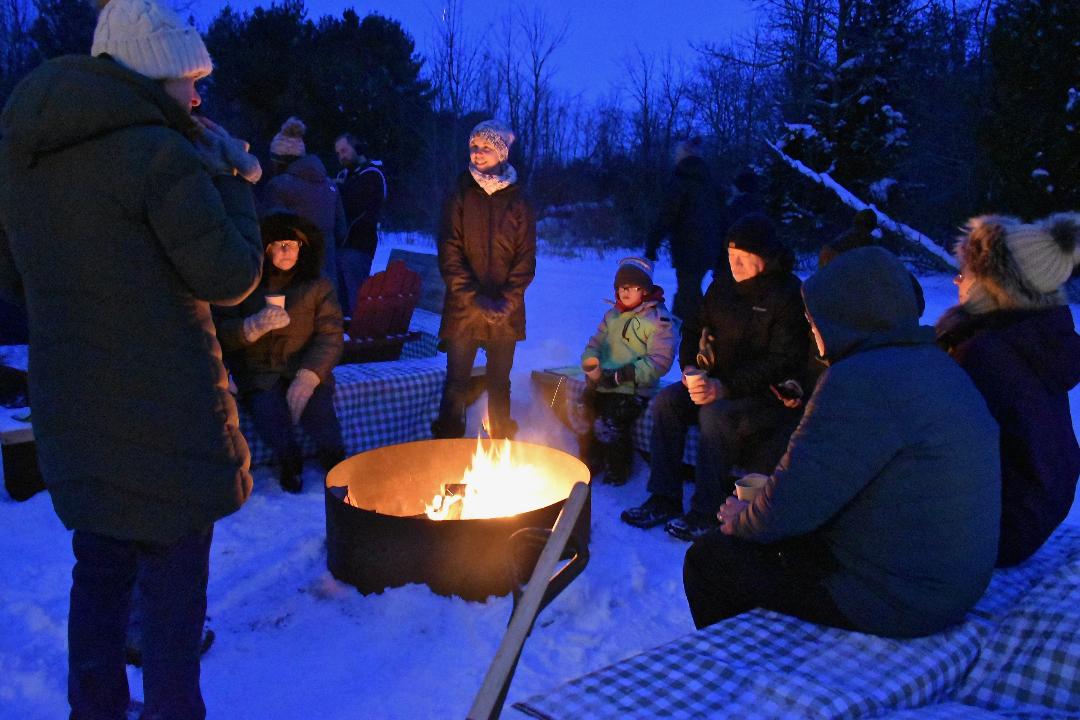
Help kick off Sturgeon Bay’s Fire & Ice Festival weekend with a candlelit walk. Join us for a roughly 1-mile hike on our trails in the enchanting glow of luminaries. Warm up afterward around a blazing campfire with hot chocolate, frosted cookies and good company.
Well-behaved dogs on leashes are welcome. Free and open to the public.
Crossroads at Big Creek, 2041 Michigan St., Sturgeon Bay
Saturday, Feb. 14
2-4 p.m. Science Saturday: Ice Harvest Demonstrations
As part of Fire & Ice Festival weekend, volunteers from the Madden Tool Museum will demonstrate how ice was harvested in Sturgeon Bay in the 1800s using simple machines. Demonstrations will be held in the Collins Learning Center Entry Garden, with historical videos screened throughout the afternoon.
Free and open to the public. Meet at the Collins Learning Center.
Crossroads at Big Creek, 2041 Michigan St., Sturgeon Bay
Tuesday, Feb. 17
3:30 p.m. Environmental Explorations: Winter Wander
Geared for elementary-aged students but open to learners of all ages. Participants will hike off-trail. Snowshoes provided if necessary.
Meet at the Collins Learning Center, 2041 Michigan St., Sturgeon Bay

