









At Crossroads, we’ve been experiencing a bit of weather whiplash this winter — a thaw one day, sleet rattling the windows the next. In Door County, that’s hardly surprising.
In fact, more than 25 years ago — several years before Crossroads at Big Creek became a nonprofit organization — when the land was still the 60-acre school forest of the Sturgeon Bay School District, rapidly fluctuating weather helped inspire the creation of a nature center.
The Sturgeon Bay Education Foundation recognized that if conditions could shift from mild to bitter in a matter of hours — as they often do — students needed a place where they could step out of the elements and continue learning.
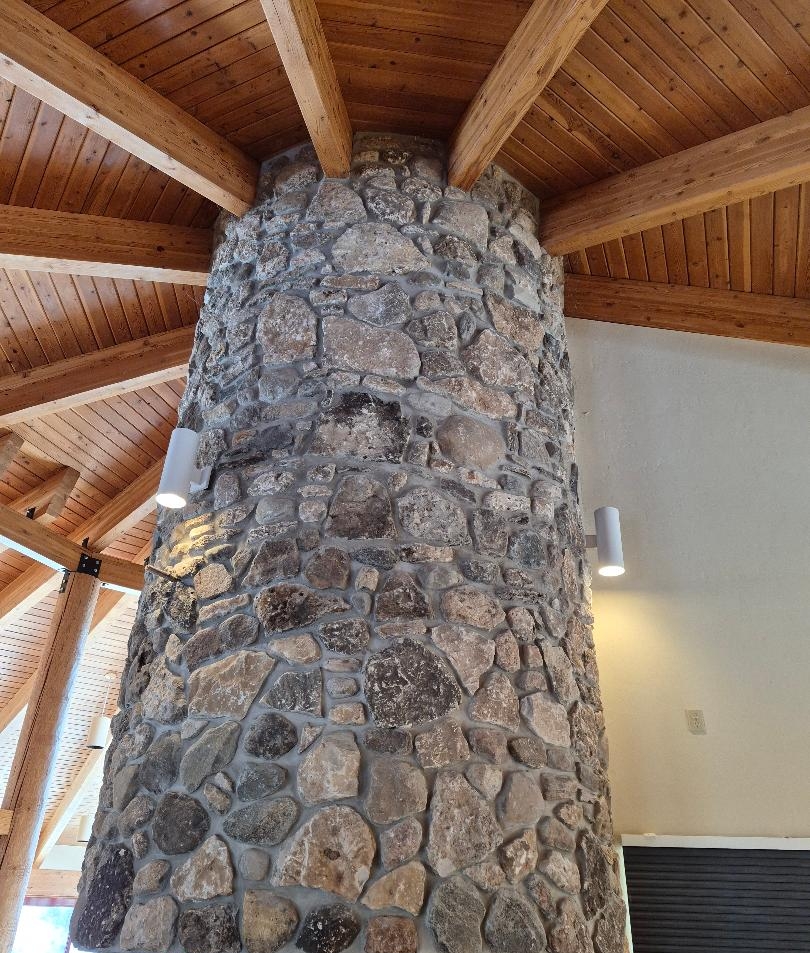
A central feature of the plan was a stunning fireplace built of Door County stone. Around that same time, a local farmer was subdividing his property, which meant dismantling an old stone wall. He invited the school to collect the rocks.
So, a group of school employees and members of the Sturgeon Bay Education Foundation board borrowed a couple of trucks and headed out. I was easily the least efficient member of the team because, for me, the outing was a fossil hunt.
I knew there would be many weather swings in the years ahead, so during construction, I asked the mason to place fossil-rich stones at about kids’-eye level. If we were going to build with ancient geologic history, we might as well make it accessible.
On Saturday, Feb. 21, at 2 p.m., our Saturday Science program will feature an Indoor Fossil Hunt. If we get a thaw, we may venture outside to search for fossils strategically placed in the entry garden. But regardless of the weather, learners of all ages will discover and identify examples of Silurian fossils indoors.
Each participating family will receive a free fossil identification pamphlet.
So why do we have fossils here?
The Door Peninsula is made of rock formed roughly 430 million years ago, during the Silurian Period. At that time, the land that would become Wisconsin was located near — and at times slightly south of — the equator. Our region lay beneath a warm, shallow tropical sea.
That sea teemed with life: solitary and colonial corals, brachiopods (often nicknamed “lamp shells”) and early relatives of modern squid. When these creatures died, their hard shells and skeletons settled into lime-rich sediment on the sea floor.
Over immense spans of time, as seas advanced and retreated, these sediments were buried, compacted and hardened into many layers of limestone.
But the rock we see today is not limestone — it is dolostone (also called dolomite rock). I sometimes say dolostone is like limestone on steroids: a little stronger, a little more resistant. The difference, however, isn’t steroids — it’s magnesium.
After the limestone formed, magnesium-rich fluids moved through the buried rock, replacing some of the calcium in the mineral calcite (calcium carbonate) with magnesium to form the mineral dolomite (calcium magnesium carbonate).
Geologists aptly call this transformation dolomitization. Scientists agree on the chemistry but continue to study exactly when, and under what conditions, those magnesium-rich fluids altered vast stretches of the original limestone.
The resulting dolostone is generally more resistant to erosion than pure limestone. That durability helped the Door Peninsula endure — and be sculpted by — the repeated advances of Ice Age glaciers that ultimately shaped the Great Lakes basin.
Stone tells the deep-time story. Fish tell the modern one.
More than 400 million years after tropical seas covered this region, the newly formed Great Lakes became a freshwater paradise for fish. But that story took a dramatic turn in the 20th century, when invasive species such as sea lamprey and alewife nearly devastated the lake ecosystem.
Next week, we will host our next Fish Tales Lecture, and we are honored to welcome Lee Kernen, retired Wisconsin DNR director of the Bureau of Fisheries Management.
In his presentation, “How Did Pacific Salmon Find Their Way to Door County?” he will offer a firsthand account of one of the most consequential management decisions in Great Lakes history.
From tropical seas to Ice Age glaciers to modern fisheries science, Door County’s story spans nearly half a billion years.
And on a bitter winter day, you can see a piece of that history without even stepping outside — just look at kids’-eye level at the stones of the Collins Learning Center fireplace.
Upcoming Programs
Saturday, Feb. 21
2 p.m. Saturday Science: Indoor Fossil Hunt
Learn about and hunt for fossils in the indoor stonework of the Collins Learning Center. Each participating family will receive a free Door County fossil pamphlet. Free and open to the public. Meet at the Collins Learning Center, Crossroads, 2041 Michigan St., Sturgeon Bay.
Monday, Feb. 24
1:30 p.m. Movie Matinee: Nature: Flyways
Join a flock of bird-loving experts and enthusiastic citizen scientists as they take on the exciting challenge of understanding — and helping save — our amazing shorebirds. Free and open to the public. Meet at the Collins Learning Center, Crossroads, 2041 Michigan St., Sturgeon Bay.
Tuesday, Feb. 24
3:30 p.m. Environmental Exploration: Science of Sliding
Find out why sleds, kicksleds, ice skates and animals move across the snow as fast — or as far — as they do. Free and open to the public. Meet at the Collins Learning Center, Crossroads, 2041 Michigan St., Sturgeon Bay.
Wednesday, Feb. 25
1:30 p.m. Wandering Wednesday
Join a naturalist-guided hike through the trails of Crossroads. Free and open to the public. Meet at the Collins Learning Center, Crossroads, 2041 Michigan St., Sturgeon Bay.
Thursday, Feb. 26
2 p.m. Schools Out Excursion: Family Fun in the Lab
Each lab table will be set up with safe (but potentially messy) educational activities that will be fun for the whole family. Free and open to the public. Meet at the Collins Learning Center, Crossroads, 2041 Michigan St., Sturgeon Bay.
7 p.m. Fish Tales Lecture: “How Did Pacific Salmon Find Their Way to Door County?”
Lee Kernen, retired Wisconsin DNR director of the Bureau of Fisheries Management, will give a firsthand account of the introduction of salmon in Lake Michigan.

