








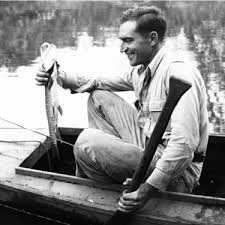
Although Aldo Leopold Day is a state observance in Wisconsin, it’s not the kind of holiday when schools and businesses close and staff receive holiday pay. Here at Crossroads, however, Aldo Leopold Day feels far more meaningful than a day off. Our mission has always been grounded in the land ethic of Aldo Leopold — the idea that humans are part of a larger ecological community and have a responsibility to care for all its members.
Beginning on Leopold Day, March 7, our Science Saturday program will move to Saturday mornings at 10 a.m. The family-focused program will be aptly titled “Learning from Aldo” and will conclude with an optional self-guided hike.
It is fitting that during this week Leopold is remembered not only for his near-poetic — and, in my case, life-changing — essays, but also as a founder of modern wildlife management. In 1933, he published Game Management, a foundational text that helped establish wildlife management as a science-based profession. In it, Leopold argued that regulations and management plans should be guided by careful research and stewardship of the entire biotic community, not short-term interests or single-species management.
That legacy inspired the creation of the Fish Tales Lecture Series: Presenting the Science of Great Lakes Fisheries. The series highlights how rigorous research and thoughtful management reflect the ethical framework Leopold championed nearly a century ago: Understanding populations, habitats and ecological relationships leads to better stewardship.
On Thursday, March 12, at 7 p.m., Dr. Dan Isermann, unit leader of the U.S. Geological Survey–Wisconsin Cooperative Fishery Research Unit, will present “Movements and Mixing of Smallmouth Bass Spawning Groups in Green Bay.” His work exemplifies the kind of long-term research Leopold envisioned — science in service to the health of the whole community. Understanding smallmouth bass behavior during spawning is critical to achieving appropriate stewardship of the fishery in Green Bay.
Using acoustic tagging technology, Dr. Isermann and his graduate students have studied smallmouth bass implanted with transmitters while actively spawning at one location. Their research reveals how these fish behave after relocation to distant release sites in Green Bay, offering valuable insight into movement patterns, spawning-site fidelity and the mixing of spawning groups.
We invite the community to spend time hiking or simply pondering the words of Aldo Leopold. Our trails are open all day, every day, free of charge. We welcome you to visit Crossroads now and throughout the year to reflect on Leopold’s enduring words: “A thing is right when it tends to preserve the integrity, stability, and beauty of the biotic community. It is wrong when it tends otherwise.”
Thursday, March 5
3:30 p.m. Nature Investigators
Geared for school-age kids, all are invited to dive into weekly, hands-on nature adventures. Each session explores a new environmental mystery — this week, predator–prey relationships. Guided by curiosity and grounded in real science, Nature Investigators encourages kids of all ages to observe, ask questions and connect with the natural world in meaningful ways. Free and open to all ages. Meet at the Collins Learning Center, Crossroads, 2041 Michigan St., Sturgeon Bay.
Saturday, March 7
10 a.m. Science Saturdays – Learning from Aldo
Learn about Aldo Leopold through engaging activities. This weekly family program is intended for elementary students, but learners of all ages are welcome. Optional self-guided hike. Free and open to all ages. Meet at the Collins Learning Center, Crossroads, 2041 Michigan St., Sturgeon Bay.
Monday, March 9
1:30 p.m. DCMGA: Growing Together Education Series – Winter Interest in the Garden
When selecting flowers and shrubs this spring, gardeners should consider plants that add beauty not only during the growing season, but throughout the year. Master Gardener Sue Kutz will offer a video presentation followed by a Q&A session. This Master Gardener program is free and open to the public. Meet at the Collins Learning Center, Crossroads, 2041 Michigan St., Sturgeon Bay.
Wednesday, March 11
1:30 p.m. Wandering Wednesday – Naturalist-Led Hike
Join a naturalist-led hike. Easy walking, approximately one hour. Well-behaved dogs are allowed. Free and open to all ages. Meet at the Collins Learning Center, Crossroads, 2041 Michigan St., Sturgeon Bay.
Thursday, March 12
3:30 p.m. Nature Investigators – Wildlife Tracks
Featured March 12 from 3:30–4:30 p.m. Geared for school-age kids, all are invited to dive into weekly, hands-on nature adventures. This week, we will examine the feet of animals in the Wildlife Exhibit — plus create a craft. Free and open to all ages. Meet at the Collins Learning Center, Crossroads, 2041 Michigan St., Sturgeon Bay.
7 p.m. Fish Tales: Movements and Mixing of Smallmouth Bass Spawning Groups in Green Bay
Dr. Dan Isermann, unit leader of the U.S. Geological Survey–Wisconsin Cooperative Fishery Research Unit, will describe how acoustic tagging technology is used to study smallmouth bass caught actively spawning and relocated to distant release sites in Green Bay. Learn how this research reveals movement patterns and mixing among spawning groups — information essential for sound fisheries management. Free and open to all ages. Meet at the Collins Learning Center, Crossroads, 2041 Michigan St., Sturgeon Bay.

