









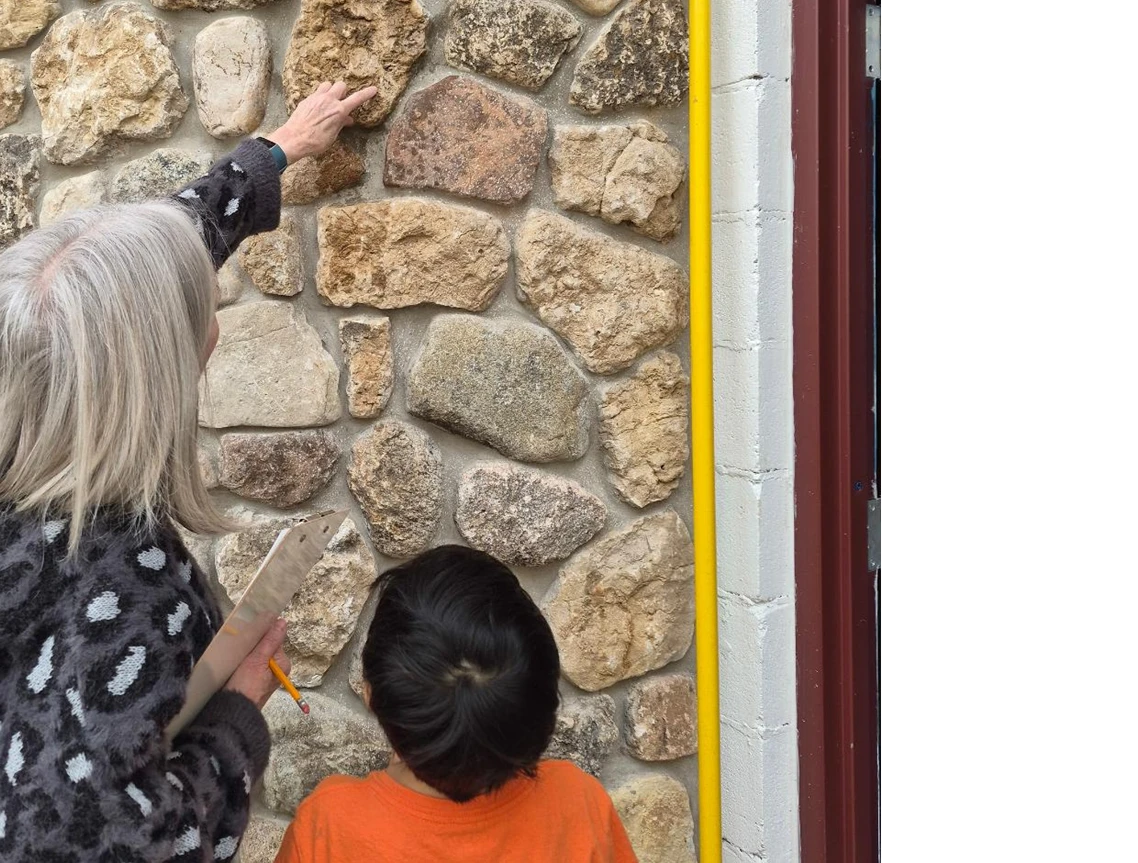
We at Crossroads at Big Creek are preparing for the sucker run, so it may seem odd that our family programs this week will feature rocks and geology. The connection, however, is direct. Without the Ice Age glaciers, the Great Lakes and their freshwater fisheries would not exist.
Rocks and fossils also play an important role in fish spawning in our creeks. Very soon, fish will leave the big lake and swim upstream because tributaries provide optimal breeding habitat. While northern pike move through streams on their way to warm, shallow wetlands—and even flooded fields with emergent vegetation—suckers (and trout) favor gravel-bottomed creeks.
The reason the creeks contain so much gravel goes back to the glaciers. During the last Ice Age, massive ice sheets moved south, crushing mountains and gouging out bedrock. The weight and movement of the ice ground rock into smaller pieces. When the glaciers melted, they deposited what geologists call “till,” a mixture of clay, sand, gravel, and pebbles.
Since the last glacial retreat, much of the finer silt and sand in local tributaries has gradually been washed downstream, leaving behind harder materials such as dolomite—often containing fossils—along with chert and igneous rocks carried south by the glaciers. Over many years, flowing water and weather have rounded these stones into pebbles.
These pebbles create ideal spawning gravel. Fish eggs slip into the spaces between the stones, where they are protected from many predators and are less likely to be smothered by silt. For spawning fish and their developing young, these rocky streambeds greatly increase survival, making tributary creeks especially valuable nursery habitat.
Fish benefit greatly from these rock-filled tributaries, but they also give back, enriching the ecosystems that sustain them.
As fish move upstream, they transfer nutrients—especially nitrogen and phosphorus—from the lake into the stream. These nutrients enter the system through eggs and milt, as well as through natural waste.
Through their foraging and energetic spawning activity, fish also stir up nutrients from the sediment and release them into the water, where they become available to aquatic plants and algae that form the base of the stream’s food web. Other wildlife feed on fish eggs, fry, and spawning adults, further linking these seasonal migrations to the broader ecosystem.
So there really will be something a little fishy about our Nature Investigators Rock Festival at 3:30 on Thursday and the Saturday Science Fossil Hunt at 10:00.
Also at 10:00 on Saturday, Habitat Healers—the Crossroads volunteers dedicated to restoration—will start the growing season with a session of “Live Stake Harvesting,” in which they will cut willow and dogwood twigs to be placed in buckets of water and planted at a later date.
And while it is early for suckers, this is about the time we begin seeing northern pike moving through Big Creek on their way to mucky wetlands, ditches, and flooded fields. Our trails along the creek and throughout the preserve are open and free of charge all day, every day.
Thursday, March 26
3:30 pm – Nature Investigators: Rock Festival
Geared for school-age kids and families, this week we investigate the characteristics of major rock types through hands-on science and music. Free and open to the public. Meet at the Collins Learning Center, Crossroads at Big Creek, 2041 Michigan Street, Sturgeon Bay.
Saturday, March 28
10:00 am – Habitat Healers: Live Stake Harvesting
Help our restoration team harvest willow and dogwood stakes for future planting. No experience necessary; all ages welcome. Waterproof boots and loppers recommended. Meet at the Collins Learning Center, Crossroads at Big Creek, 2041 Michigan Street, Sturgeon Bay.
Saturday, March 28
10:00 am – Saturday Science: Fossil Hunt
A family-friendly hunt for Silurian fossils. Rain or shine (we’ll move indoors if needed). Geared toward elementary students but open to all. Meet at the Collins Learning Center, Crossroads at Big Creek, 2041 Michigan Street, Sturgeon Bay.

