









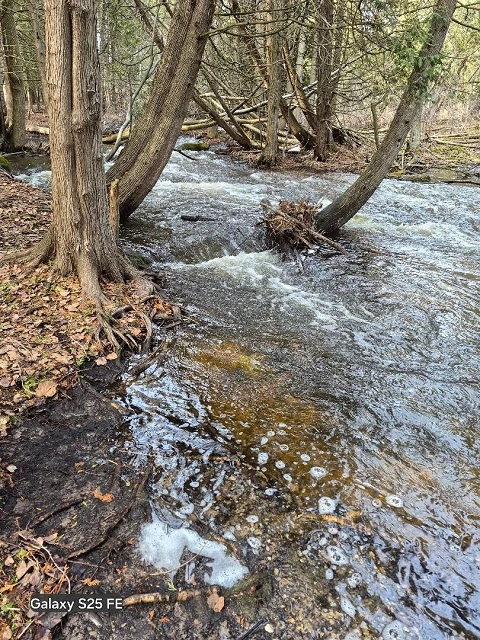
Excessive early spring snow and rain forced Big Creek over its banks. So, as we at Crossroads celebrate migration—birds, fish, frogs—we are eager to see if the abundant water will affect their behavior and reproductive success. This spring, we will be wildlife and bird watching. Throughout the sucker run, Crossroads will also be deploying wildlife cameras along the Big Creek corridor to monitor activity and see what other species are utilizing the creek during this time of year.
Last spring, we offered a class called “Birding with Merlin” for Learning in Retirement, and we have seldom received such positive feedback. (In fact, LIR has asked us to repeat the class this May.) Participants told us that Merlin truly opened up the world of birdwatching for them.
The free Merlin Bird ID app—named for both the legendary wizard of King Arthur’s court and a small falcon—was created by the Cornell Lab of Ornithology. This AI-powered tool can identify birds by photo or sound, using location and date to provide reliable suggestions right on a smartphone.
But even powerful tools have limits.
Developers and experienced birders alike caution that Merlin can make mistakes. I know from experience: when I bird while wearing a certain pair of corduroy pants, the app insists I’m hearing a ruffed grouse. Nope—just my legs brushing together. Errors like that can still end up recorded as sightings.
There’s also a tendency for some users to focus on adding as many species as possible to their lists without taking time to truly observe and verify what they’re seeing. Birders even have a lighthearted term—“zombie birder”—for someone focused more on their phone than the world around them.
At Crossroads, we welcome listers—and yes, even “zombie birders.” But this week, we’re encouraging something more: behavior watching.
Use Merlin—but don’t let it do all the birding for you.
Go beyond identifying a bird. Watch what it’s doing—and where: feeding, nesting, calling, and interacting with its habitat. The same goes for mammals and amphibians.
Our programs this week reflect that approach. Nature Investigators, our Thursday afternoon family program, will focus on “Signs of Life,” encouraging participants to observe birds, fish, and frogs in their habitats. Science Saturday will emphasize behavior over identification. Our seasonal Monday Matinee highlights the fascinating spawning behavior of suckers.
This spring, we invite you to get in touch with nature at Crossroads. Turn on your Merlin app if you like—but don’t stop there. Look up. Look around. The natural world is full of stories waiting to be noticed.
Wednesday, April 15
10:00 AM – Junior Nature Club
A free series designed to help preschoolers connect with nature. Caregivers are expected to stay with children. Meet at the Collins Learning Center, Crossroads, 2041 Michigan St., Sturgeon Bay.
1:30 PM – Wandering Wednesday: Naturalist-Led Hike
Enjoy an easy, hour-long hike with a naturalist. Well-behaved dogs on a leash are welcome. Free and open to the public; no registration required. Meet at the Collins Learning Center, Crossroads, 2041 Michigan St., Sturgeon Bay.
Thursday, April 16
3:30 PM – Nature Investigators: Signs of Life (Wildlife!)
Geared toward school-age children. Participants will look for birds, frogs, and spawning suckers while observing behavior and habitat. Meet at the Collins Learning Center, Crossroads, 2041 Michigan St., Sturgeon Bay.
Saturday, April 18
10:00 AM – Science Saturday: Bird Behavior
For learners of all ages. We’ll go birding with a focus on behavior—not just naming species. Free and open to the public; no registration required. Please dress for the weather. Meet at the Collins Learning Center, Crossroads, 2041 Michigan St., Sturgeon Bay.
Monday, April 23
1:30 PM – Monday Movie Matinee: Sanctuary and Suckers
Plovers nest, suckers spawn, and storms rage! This video explores environmental successes around the Great Lakes. Free and open to the public. Meet at the Collins Learning Center, Crossroads at Big Creek, 2041 Michigan St., Sturgeon Bay.

